Season by Season
Stuart sits in a mild temperate band, so you don't get the hard freeze-thaw swings that crack torsion springs up north or the deep summer heat that warps panels in the desert Southwest. That's the good news. The steadier news is that a door here doesn't get a seasonal break from use - there's no month where the door sits idle and hardware gets a rest. Wear here is a slow, even grind that builds across the whole year instead of spiking in one brutal cold stretch.
What that means practically: you won't hear your spring snap on the first freezing morning like a homeowner in Ohio might. Instead you get a gradual change - a door that used to lift with one smooth pull starting to catch, hesitate, or need a shove partway up. That gradual change is easy to explain away as "it's always been a little stiff." It hasn't. It's been getting stiffer for months, and the mild climate just means the decline is quiet instead of dramatic. Pay attention to small, steady shifts, not just sudden breaks. In a place like this, the sudden break is usually the last stage of a problem that announced itself weeks earlier, quietly, if anyone was listening.
What Local Conditions Do
The service area runs from North River Shores and Sewall's Point, both about three miles out, through Jensen Beach and down to Port Salerno at five miles, then out to River Park and Hobe Sound at ten, Indian River Estates at twelve, White City at fourteen, Jupiter Island at fifteen, Fort Pierce South at sixteen, and Tequesta and Indiantown at eighteen. Across all twelve of those communities, the housing stock repeats itself: mostly 1980s and 90s construction, with the broader area's homes built between 1969 and 1988, median year 1983.
That matters because garage door hardware doesn't fail on a fixed calendar - it fails based on cycle count and age, and age is the one thing almost every house in this service area shares. A door installed when a subdivision near Jensen Beach was new is now past 35 years old even if nobody's touched it. The mild climate didn't age it faster or slower than a house up the coast; it just means the aging has been steady rust-free wear on moving parts rather than weather damage, which is a different kind of failure to listen for.
What Is Going On
With roughly 19,430 owner-occupied houses across the service area, most dating to that same 1969-1988 window, a lot of doors are hitting the same age wall at roughly the same time. That's why certain sounds show up over and over on service calls in these neighborhoods rather than being random.
A rhythmic thump once per rotation usually means a roller has flattened on one side - common once a door's rollers pass the few-thousand-cycle mark, which a 1983-median house has cleared many times over. A sharp bang followed by the door refusing to move is almost always a broken torsion spring; the door isn't jammed, it's lost half its lifting force. A grinding or scraping that gets worse as the door travels points to a track that's bent or pulled from the wall, not lubrication. And a loud pop on the way up, followed by the door sagging on one side, is often a cable giving way on original 1980s-era hardware that was never replaced.
We can't tell you which one it is from a description over the phone - vibration, pitch, and timing matter, and those are easy to describe wrong. But the pattern is real: these are old-house noises, not new-house noises.
Checking It Yourself
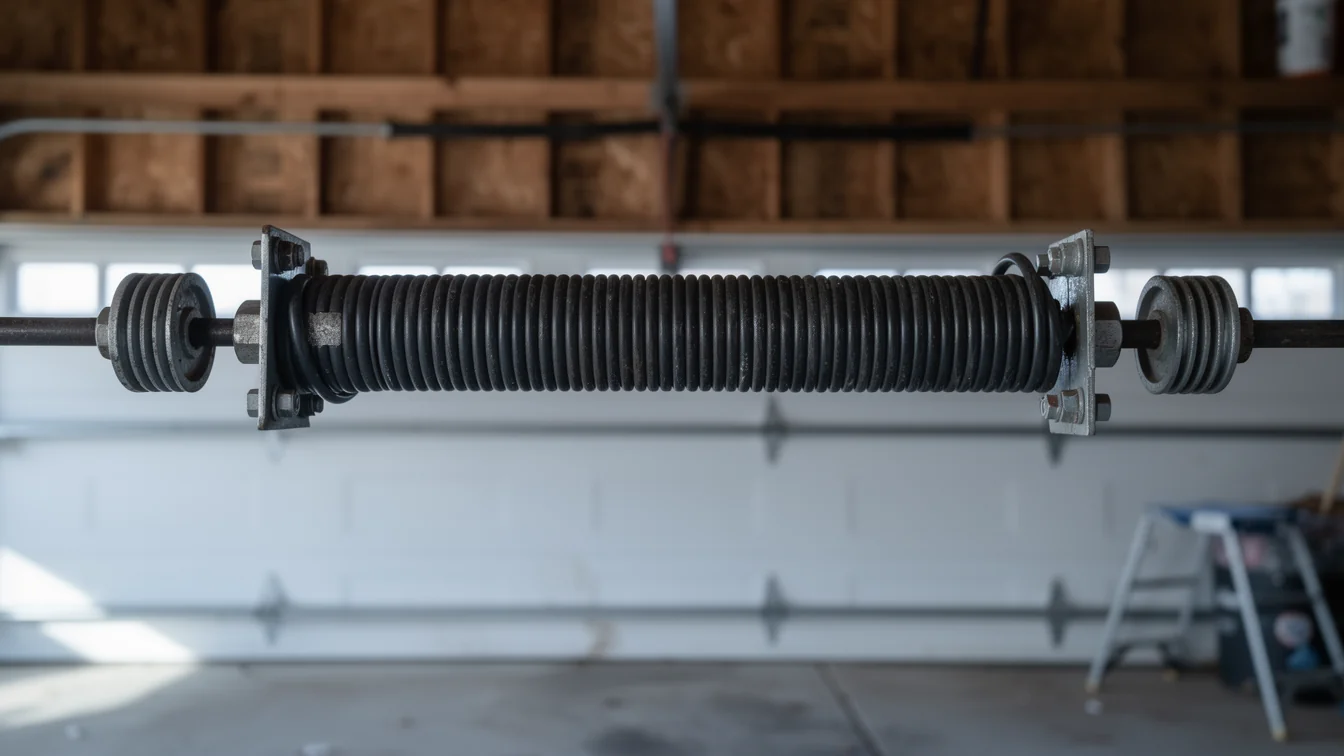
Before you call anyone, there are a few things you can check safely from the garage floor, door down. Look at the springs above the door - if one looks longer or more stretched than its pair, or if there's a visible gap in the coil, that's a spring on its way out and the door shouldn't be run until it's looked at. Check the cables on either side of the door for fraying or rust; a cable that's furred or orange instead of smooth steel is near the end of its life, which lines up with homes near the median 1983 build year.
Listen for where the sound happens in the door's travel, not just that it happens - a noise only at the top is usually different hardware than a noise only at the bottom. Open and close the door by hand with the opener disconnected, if you can do that safely, and feel for binding; smooth by hand but rough with the opener running usually points to the opener, not the door.
What we won't tell you to do: touch anything under spring tension yourself. A wound torsion spring holds enough force to break bones, and on a door this age, the spring is exactly the part most likely to be past its service life.
Talk to a local pro
Garage door trouble in Stuart?
Same-day service with honest, upfront quotes.